Insights
AI vs. human design — what businesses should actually outsource
What we hand to AI without thinking twice, what never leaves the team, and the line between the two — drawn from running the work inside our own agency.


Every founder we talk to has tried AI design tools by now, and most of them describe the same afternoon. The first draft looked genuinely good. Then someone senior opened the file and asked a question the tool had no answer for: what is this slide actually trying to say?
That question is the whole debate, compressed. Not whether the output looks finished — it almost always does — but whether anyone in the room can tell what it was for. So instead of adding another opinion piece to the pile, here is how we split the work inside our own agency: what goes to AI without a second thought, and what never leaves the team.
What we hand to AI without hesitating
A wrong direction at hour one costs nothing. The same wrong direction discovered in week four costs the project. That is the entire logic behind where AI sits in our process: early, cheap, disposable stages — the ones where being wrong is free.
- Moodboards and references. Forty visual directions in an hour beats a day of scrolling, and nobody misses that day.
- Layout exploration, before anyone commits to a structure worth defending.
- Resizing one design into twelve output formats — work no human should still be doing by hand.
- First-draft copy, as long as everyone understands how much weight the word “draft” is carrying.
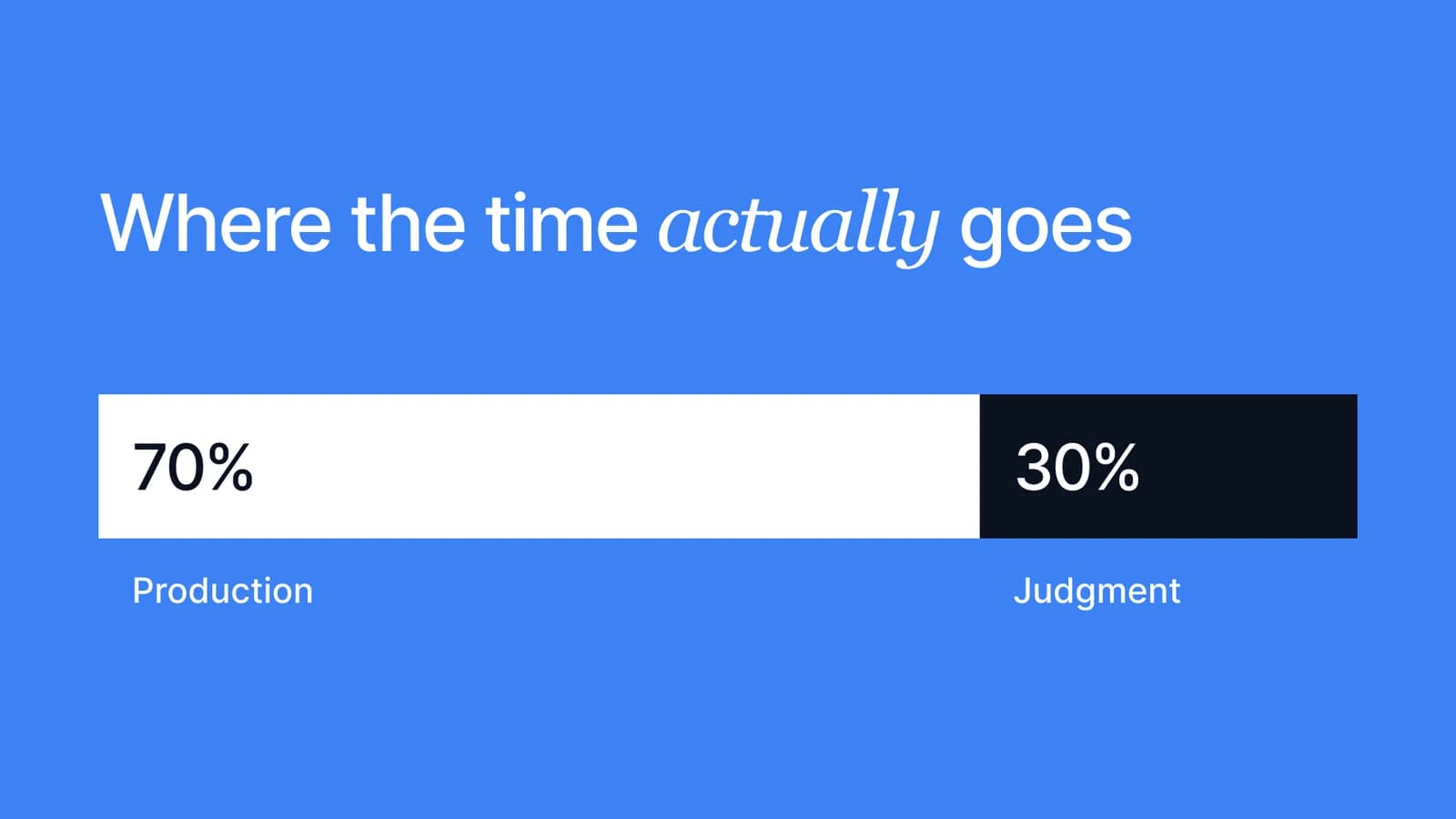
If we had to put a number on it: roughly 70% of design production time is mechanical. Alignment, spacing, versioning, cleanup. AI eats that layer, and good riddance.
Where it falls apart
Here is the pattern in the files clients bring us to fix. The AI output is never ugly. It is hollow. Every slide looks finished and says nothing, because the tool was optimising for “looks like a good slide” rather than “makes this specific room believe this specific thing”. Those are different jobs, and only the second one gets paid for. It is the same reason presentation design still wins business: the value is in the argument, not the arrangement.
Take an investor deck. Rebuilding one for a funding round is not picking the best-looking option from a set of variations — it is making an argument about how a company should be understood, in a room where that understanding decides whether the round happens. Every slide either serves that argument or dilutes it.
Or a leadership dashboard. Which number sits top-left is not a layout question. It quietly defines what the CEO worries about on Monday morning. No tool knows that, and it cannot know it — it was not in the room when the board argued about targets. Same with brand work: a tool will generate a logo in a minute, but it cannot tell you whether that logo survives contact with your market and your next five years. None of these are taste problems. They are context problems.
The part nobody brings up
There is a quieter issue, and it comes up far less often than it should. Think about what actually goes into these files. Pitch decks carry financial projections. Dashboard projects expose internal KPIs. Brand strategy describes exactly how you plan to beat your competitors. And teams paste all of it into consumer AI tools without reading a line of the data policy. If you have confidentiality obligations to investors, clients, or a board, work out where those files live after upload before the brief goes out — not after. We cover it properly in design confidentiality in the age of AI tools and in what business materials to keep out of AI tools.
The frame that ended up working
The question was never whether to use AI in design. Of course you should. The question is which parts of the work need a person to be accountable for them. Our answer, after a fair amount of trial and error: AI is a research and drafting layer — references, variations, mechanical production, rough copy. People own judgment and anything client-facing — narrative, hierarchy, brand calls, final execution.
Raw AI output never ships. If a file carries your company's name in front of an audience that matters, it goes through people who understand what is at stake.
That line will keep moving as the tools improve, and it is worth redrawing each project rather than settling once. But it moves in one direction only: the closer the work gets to a decision that matters, the more it depends on judgment a tool cannot supply. The teams getting real value from AI are not the ones replacing designers. They redrew the line between production and judgment, and staffed both sides properly. The tools will keep getting better at production. Production was never the expensive part.
Frequently asked questions
What design work should I keep human, and what can AI do?
Give AI the early, low-stakes layers: references, layout exploration, resizing, first-draft copy. Keep people on judgment — brand decisions, the narrative of a deck, the hierarchy of a dashboard, anything a client sees. The cost of a wrong call rises the closer the work gets to a real decision.
Is AI design good enough for business use?
For internal drafts and speed, often yes. For work that carries your company's name in front of investors, buyers, or a board, the tool can draft but not decide — and the deciding is the expensive part.
What are the risks of using AI for design?
Two. Output that looks finished but communicates nothing, and sensitive material uploaded into tools whose data policy was written for general use. The first is a judgment problem, the second a confidentiality one.
Work with us
Need help with
your next project?
Branding, presentations, web, or dashboards — tell us what you are working on and we will share a path forward.
Keep reading
All articles
AI presentation tools vs design agency: what businesses should choose
What we hand to an AI presentation tool without thinking, what we never let it near, and the moment in a room where the difference shows up.
Read article
Design confidentiality in the age of AI tools
Every design brief starts with the creative question. Almost none start with where the files end up — which is the one that has started to matter.
Read article
AI website builders vs professional web design: what businesses should know
A builder will give you a page in an afternoon. Whether that page explains your business to someone deciding whether to contact you is a different problem entirely.
Read article