Process
What to send your presentation designer (it changes the price)
The same 20-slide deck costs $900 or $2,000 from the same studio. The difference is usually not ambition — it is what arrived in the first email.


The same 20-slide deck can cost $900 or $2,000 from the same studio, and the difference is usually not ambition. It is what arrived in the first email. Content readiness is the single biggest lever on presentation pricing, and it is the one lever entirely in the client's hands.
Final text, or an honest draft
Finished, approved content is the cheapest project you can buy: the designer structures, designs, ships. When the text is half-formed, someone senior has to do editorial work — deciding what the deck is trying to say — and editorial time is the expensive kind.
An honest draft beats a polished lie. A rough document saying “we don't know how to end this” is more useful than a confident wall of text three stakeholders have not agreed on. The most expensive projects we see are the ones where content gets renegotiated internally after design has started; every internal compromise arrives as a revision request. If the text genuinely is not ready, say so and buy the structural work explicitly — it exists as a service. It just should not arrive disguised as “small text edits” in round two.
Brand assets, in their original formats
Logo in vector — SVG, EPS or AI, not a screenshot from the website. Brand guidelines if they exist, even old ones. Fonts, with names, or at least a licence status. Approved photography if you have it. Guidelines covering only a logo and two colours are normal, and any competent studio extends them for presentation use. What slows a project is not thin guidelines; it is guidelines that exist and arrive in week two, after the concept was approved against nothing.
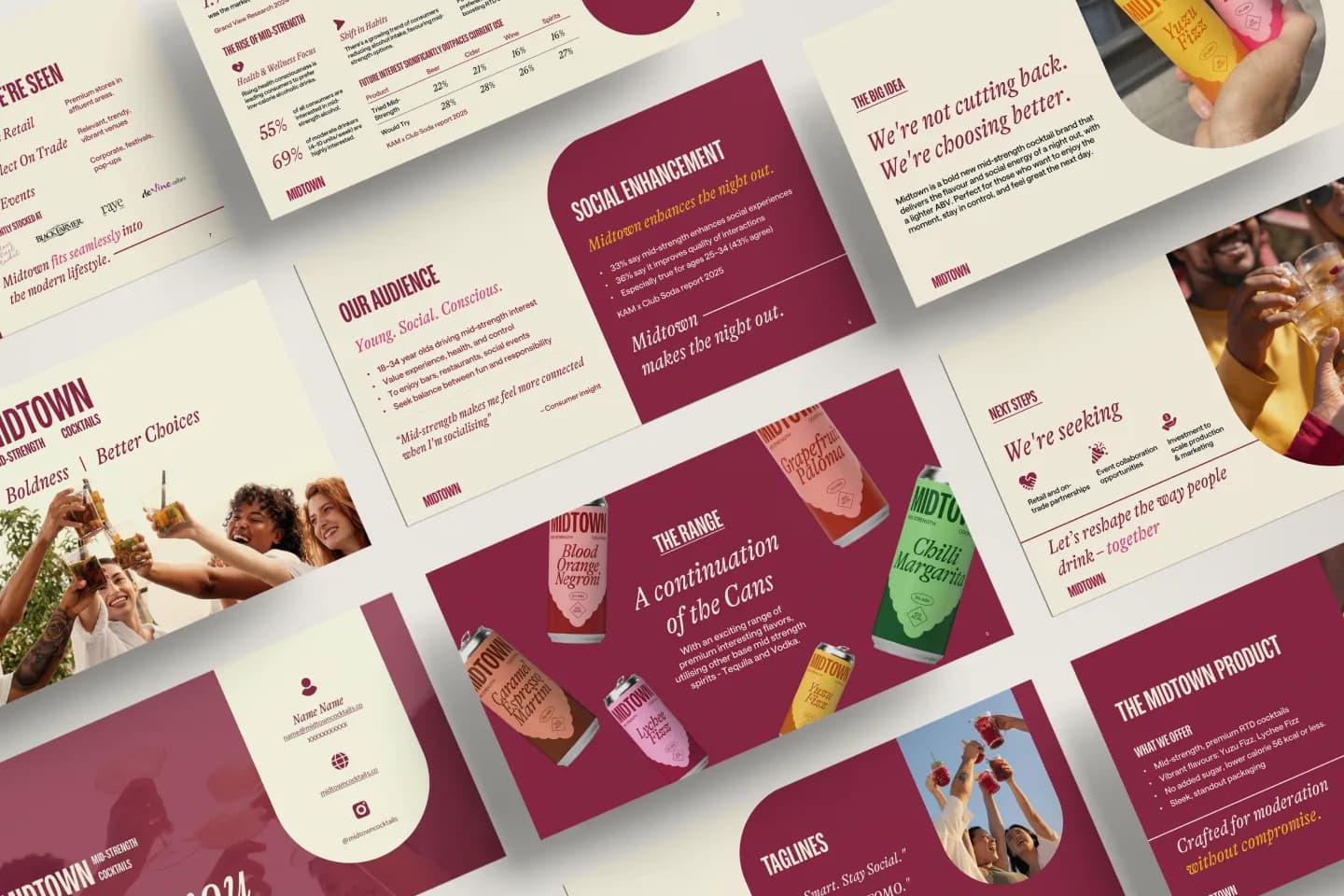
Two or three references, with one sentence each
Send examples you like — decks, sites, anything — with a sentence about what you like: the restraint, the density, the chart style. Three references with reasons beat thirty without. Also useful and rarely sent: one example you dislike. It fences the direction faster than ten positive ones. You are not designing the deck by sending references; you are shortening the distance between concept one and the concept that gets approved, and that distance is measured in days.
The three answers that shape everything
Who is in the room, what should they do after the last slide, and how will the deck be used — presented live, sent cold, or both? Those three change layout density, slide count, title style and chart depth. A deck read on a phone by an investor and a deck projected at a summit are different products that happen to share a file format. Deadlines belong here too, stated honestly: a real deadline is a constraint we plan around, a false-alarm deadline discovered in week three is how quality gets rationed.
What not to send
- A folder of every presentation the company has ever made, unlabelled.
- Fragmented feedback channels, agreed before the project even starts.
- A template you already dislike, with instructions to make it work. If it worked, you would not be writing to a studio.
Finished content and three referenced examples remove most of the concept-phase risk and at least one revision round — often 20 to 30 percent of the invoice, and up to a week of calendar.
The same preparation logic applies to any design engagement, not just decks — we set out the general version in how to write a design brief, and what the tiers themselves cost in presentation design pricing.
Frequently asked questions
What if we have no brand at all?
A normal starting point, not a blocker. The deck's visual system gets designed first and often becomes the seed of the brand. Say it upfront so the concept phase is scoped in.
Should we send speaker notes?
Yes, if the deck will be presented. They tell the designer what does not need to be on the slide, which is half of good slide design.
How much does good preparation actually save?
On typical projects, finished content and clear references remove most concept-phase risk and at least one revision round — often 20 to 30 percent in money, up to a week in calendar.
Can we start before the content is final?
Structure and visual concept can start from a draft. Producing every slide from unapproved text is how projects get built twice and billed once and a half.
Work with us
Need help with
your next project?
Branding, presentations, web, or dashboards — tell us what you are working on and we will share a path forward.
Keep reading
All articles
What business materials should not be uploaded to AI tools
The files teams paste into AI tools without thinking, what is actually inside them, and the three questions that settle most cases before you hit upload.
Read article
Design confidentiality in the age of AI tools
Every design brief starts with the creative question. Almost none start with where the files end up — which is the one that has started to matter.
Read article
The week before launch — how we close projects
The work is done and the risk is not. What happens in the last five days is the difference between a delivered file and a launch that lands.
Read article